Friday, October 05, 2007

Global protests call for UN Security Council action on Burma/Myanmar

Media Release: Embargoed until 00:01 Saturday 6th October

(includes advisory details for international events)

Global protests call for UN Security Council action on Burma/Myanmar:

Thousands/Hundreds expected on streets of YOUR CITY

Tens of thousands of campaigners are expected to take to the streets of capital cities around the world today (Saturday), including YOUR CITY, to call for urgent UN action on Burma/Myanmar.

The campaigners are standing in for the monks under arrest and those who would be shot if they tried to protest in Burma/Myanmar.

“Our friends and families in Burma cannot take to the streets so today we will do it for them. We may be far away but that does not mean we are powerless - we must speak up for those who cannot speak for themselves and keep the world’s attention focussed on their plight,” said Myo Thien, a Burmese refugee who fled the country in 2003.

Protests will start at 12-noon in dozens of countries around the world and on five continents (for a list of events and contact details please see editor’s notes).

The international day - supported by the Burma Campaign, Amnesty International, Human Rights Watch, the International Trade Union Congress, the International Federation for Human Rights (FIDH), Avaaz, the US Campaign for Burma and hundreds of other groups - is calling for UN Security Council action to address the crisis.

Campaigners are also urging the international community to do more to keep the pressure on the Burmese/Myanmar government until the military crackdown ends and all political prisoners are released.

“Because the media pictures have gone and we can’t see what’s happening does not mean the crisis has ended, far from it. Now is the time we need to draw attention to what’s happening behind closed doors or atrocities will increase. Today we’re saying we haven’t forgotten you, we are watching,” said a spokesperson for the campaign.

Around the world campaigners will wear red headbands in solidarity with the monks under arrest and tie these onto government buildings, religious shrines or key landmarks to signify the thousands of lives currently hanging in the balance.

In INSERT YOUR CITY, the day of action will be INSERT DETAILS OF YOUR EVENT (This should include times, location and an explanation of the photo opportunity)

“The NAME government must do more to end this crisis. The media pressure may have decreased but the people of YOUR COUNTRY are saying we expect you to act to end the violations of basic human rights,” said INSERT LOCAL ORANISERS NAME, who is organising the INSERT CITY events.

Editors Notes:

For more details or interview please contact:

INSERT YOUR COUNTRY: YOUR PHONE NUMBER

Country, City

Event

Start Time. [Date is 6th October unless stated otherwise].

Contact: Phone/Email

AUSTRALIA,

Melbourne

Bring banners, placards,

saffron colored shirts.

12.00

Amnesty International Australia + 61 2 92 17 76 00

www.amnesty.org.au

For all others:

Australian Burmese Network

+61 (0) 422463178

AUSTRIA, Vienna

Rally: Monk Gyosei Masunga will 'play the drums - for peace in Burma' at Stock im Eisen (near Stephansplatz). Wear red

12.00

Austrian Burma Campaign

+43 (0) 699 1000 7645

BELGIUM, Brussels

March at Place de la Liberté.

12.00

Amnesty International Belgium (fr)
+ 32 2 538 81 77
www.aibf.be

Arnaud Collignon acollignon@aibf.be


Clarence Jameson cjameson@aibf.be

CANADA,

Toronto

Candlelight vigil and march which will begin in front of the China Consulate.

12.00

Mynthura Wynn: 416-533-3656 or C: +! 416-882-3868, Ulla Laidlaw: +1 416-605-2588, Carol Lee:+1 647-588-9758

CHILE,

TBD

TBD

TBD

DENMARK, Copenhagen

Rally at Chinese Embassy

10.00,

5th Oct

TBC

FRANCE, Paris

Rally at Parvis des droits de l'homme du Trocadero

12.00

Vassaly Sitthivong contact details to follow.

GERMANY,

Berlin

TBD

TBD

TBD

HONG KONG

TBD

TBD

TBD

INDIA, Bangalore

New Dehli

Pune

March

March

March

12.00

12.00

18.00

Dr. Zawwin Aung

Burmese Trade Union Leader

+91 9871 578 569

drzawwinaung@gmail.com

IRELAND, Dublin

Rally with flowers at O'Connell Bridge

12.00

+353 1 286 0497

JAPAN

TBD

TBD

TBD

LUXEMBOURG

TBD

TBD

TBD

MALAYSIA,

Kula Lumpur

Rally at KLCC (entrance near the Menara Maxis)

20.00 5th Oct

Moon Hui and K. Shan + 60 3-77843525, +60 3-79552680

suaram@suaram.net

MONGOLIA, Sukhbaatar

Multi-faith rally

11.00

Amnesty International Mongolia
+976 11 324 705
www.amnesty.mn

NEW ZEALAND,

Wellington

Rally at Civic Square

12.00

Andrea Valentin avalentin@business.otago.ac.nz

Amnesty International NZ
+ 64 4 499 3349
www.amnesty.org.nz (for Christchurch and Dunedin)

NETHERLANDS

TBD

TBD

TBD

NORWAY, Oslo

Demonstration, wear red

12.00

Kathrine Sund, contact details TBD

SOUTH AFRICA, Cape Town

Rally at the Company Gardens

12.00

Craig Ackermann widebluecraig@gmail.com

SOUTH KOREA, Seoul

Rally at Burmese Embassy

12.00

TBD

SPAIN, Barcelona

Day of Action for Burma

12.00

Concha Pinós birmaniaporlapaz@yahoo.es

+34 639419772

birmaniaporlapaz@yahoo.es

http://birmaniaporlapaz.blogspot.com/

SWEDEN, Umea

Rally at Mimerskolans Bollplan

12.00

Markus Maunula, info@burmakommitten.org

+46 47 22 47 92 37

SWITZERLAND, Geneva

Rally at 1242 Satigny

12.00

Assoc. Suisse-Birmanie

+41 12-13564-9

asboffice@bluewin.ch

THAILAND, Bangkok

TBD

TBD

TBD

TAIWAN, Taipai

Rally at National Taiwan Democracy Hall, wear red

12.00

Peter Dearman

dearpeter@gmail.com

USA,

San Francisco

Washington DC

Justin Herman Plaza

March from Burmese-

Chinese- Indian embassies

12:00

TBD

Thelma, Campaigns Coordinator

U.S. Campaign for Burma

1444 N Street, NW, Suite A2

Washington, DC 20005

Tel: (202) 234 8022

Fax: (202) 234 8044

Web: www.uscampaignforburma.org

UK,

London

March with monks from Tate Museum, wear red

11.00

Gemma.mortensen@crisisaction.org

+44 (0) 20 7324 4748,

+ 44 (0) 7791 586 211

Mark Farmaner The Burma Campaign UK

+44 (0) 7941 239 640, +44 (0) 207324 4713

ENDS

Thursday, October 04, 2007

Free Burma!


Information

Event Info
Name:
Support Burma: International Bloggers' Day
Host:
Support the Monks' protest in Burma
Type:
Time and Place
Date:
Thursday, October 4, 2007
Time:
1:00am - 11:55pm
Location:
Wherever you are
City/Town:
Rangoon, Myanmar

Description

Details on http://www.free-burma.org/


***********************************************
Here is how to take part in tomorrows (4th oct) action.


1. Publish a posting (Bulletin Board, Forum, Blog, Social Network, Static Website…) on the 4th of October with the header: “Free Burma!”

2. If possible Tag it with "Free Burma"

3. Choose a grafic from here:
http://free-burma.org/graphics.php

4. Link to www.free-burma.org there your readers will find some informations about the campaign and Burma and a participant list which you can join.

5. Write a Text or anything about burma if you like

6. Register your name and url in the participants list here:
http://free-burma.org/index.php

7. Tell your friends

***********************************************

International bloggers are preparing an action to support the peaceful revolution in Burma. We want to set a sign for freedom and show our sympathy for these people who are fighting their cruel regime without weapons. These Bloggers are planning to refrain from posting to their blogs on October 4 and just put up one Banner then, underlined with the words „Free Burma!“.

Here, we are coordinating a effort of these bloggers and webmasters. The links in the german section of this paragraph show how the idea came into being.

You can keep up with the changes to this wiki by pointing your feedreader to http://freeburma.stots.de/feed.php

Monday, May 28, 2007

New Interns for 2007

Two interns were chosen for 2007. Read the profile of the new interns from Malaysia and Mongolia:


(NB: THENCY GUNASEKARAN from Malaysia is an active blogger, read more about her at: thencysfootprints.blogspot.com


I’m Thency and by nature I am a very friendly, energetic, passionate, adaptable and practical person. Professionally I enjoy exploring new ideas and concepts, looking for innovative ways to solve any problems or situations that might arise during the course of my work. I like to try different ways of doing things instead of always following what has been tried and tested. I am able to work independently with minimum supervision but at the same time I am also able to work in a team.

My passion lies in human rights issues with a special focus on trafficking of women and children for the purpose of sexual exploitation and forced labor. I consider human trafficking a form of slavery and believe it should be eradicated with utmost vigor. In recent times I have been working with marginalized communities using a rights based approach as well as active participation from the community itself. This has served to remind me of the importance of knowing one’s rights to be able to actually claim them when they are violated. I strongly believe that education and awareness are very vital elements when we talk about rights and democracy. By education I’m not referring to an institutionalized education. I’m actually referring to the process of raising awareness as a whole. One does not need to be highly literate to know one’s rights or to be entitled to one’s rights. A person is entitled to their rights regardless of their status. This is something that I will work on in future. Many people aren’t aware of this and sadly this contributes to their rights being continuously violated.

Where skills are concerned my strength lies in organizing events be it workshops, trainings or others. I am also a competent public speaker who enjoys sharing information with people. I enjoy conducting trainings as well. I take great delight in working with and interacting with people. The human mind is something that continues to fascinate me till today. I have had the opportunity to attend various trainings on topics that range from Gender-based violence, good governance, leadership, professional etiquette, conflict mediation, presentations and public speaking, child sexual abuse, personal safety for children, writers for women’s rights and marketing. All these workshops have helped me to open my thinking and look at things from various perspectives. As for my hobbies, I enjoy reading, listening to and playing music, dancing and meeting people from various backgrounds. These activities serve as a method for me to relax and unwind after working. Everything that I have involved myself in and participated in has served to mould me to be what I am today. My passion and interest to bring about change is a strong drive factor that pushes me to try and do what I can to bring about a better understanding and respect for human rights in my country.

My expectations, objectives, and interests on the human rights internship program.


I first heard about the May 18 Human Rights Internship Program last year. At that time the program and learning experience it had to offer intrigued me. Unfortunately I couldn’t apply for it then. A year down the road, my interest in the program has increased as during this past one year, I have had the opportunity to read, listen and learn a little bit about the foundation, its purpose and aims as well as the role it plays in promoting human rights and democracy.

I have been involved in voluntary work since 2003 only. Although my interest and passion has always revolved around issues affecting humans, justice and equality, I only got the opportunity to actively do something constructive when I entered university. Since my university days I’ve been actively involved with local Non-governmental organizations (NGOs) – mainly with groups working on women’s rights, child’s rights and youth development.

I’ve been an active member of AIESEC, a global youth run organization that aims to foster peace and understanding via developing the potential of young people, sensitizing them towards social issues and providing them with the opportunity to experience and understand various cultures. I believe that peace can only be achieved when humans learn to accept each other without prejudice. My time in AIESEC exposed me to the reality that many young people are actually not aware of what’s happening around them, in the world. Thus I made it one of my goals to incorporate a stronger presence of political and social issues within my organizations’ activities and projects. I took up the role of the person in charge of member development. This enabled me to plan my members learning. I utilized this platform to reach out to the youth in my university to raise awareness about important issues like human rights, gender issues, child’s rights, women’s rights, HIV/AIDS, globalization, the state of the indigenous people and the importance of cultural awareness and sensitivity.
At the same time, my volunteer work with the local NGO’s exposed me to the harsh realities of the human rights and political scenario in Malaysia. I realized all was not well. This exposure has helped shape and challenge my thoughts and viewpoint. I became convinced that working for human rights is something that I wanted to do. Hence my decision to work with Empower right after my graduation in 2006. Working with Empower has given me the opportunity to experience working at the grassroots level with marginalized communities as well as doing work like administrative tasks, organizational tasks, report writing, training and so on. Empower uses the rights based approach in our training and project. This has enabled me to familiarize myself with instruments like the Convention on the Rights of the Child, Convention on the Elimination on All Forms of Discrimination Against Women, The Universal
Human Rights Declaration and this has in turn reinforced my believe that education and awareness about the importance and the value of freedom and rights is a vital element in ensuring that a person’s right is upheld. I strongly believe that it is extremely important for society to be aware that a lot of things that they take for granted or struggle for is in actual fact a basic right.

One of the main reasons for my interest in the internship program is that having read about the May 18 Uprising incident, having met and spoken to some Koreans, I realized that there is a sense of patriotism and pride that they exude when they speak about their country’s struggle for democracy. It struck me that these are people who seem to truly appreciate democracy and their freedom. This is something, sadly not very apparent amongst the Malaysian youth I’ve met. Not many youth seem to realize that the price for democracy and freedom has been great…..it doesn’t come easy.

I believe that I can learn a lot from this internship. I would like to know what is it that makes the Koreans so aware of the importance of democracy, freedom and the up-keeping of human rights in a nations survival and growth. I’d like to bring that knowledge to share with the youth of my country as I believe that the youth play a crucial role in the quest for freedom.

My objectives for applying for this internship would be to gain more exposure and knowledge about the Korean struggle for democracy. I’d like to know about the history of the struggle and what is it that continues to drive the people to strive to maintain democracy and respect human rights. I would also like to learn and observe how Korean NGOs work, the approach that they use when handling human rights issues. I would also like to bring back what I would learn in Korea to share with my fellow activists in Malaysia. I believe that the theoretical knowledge as well as the practical experience I would gain from this internship will prove to be invaluable in my quest to promote and uphold human rights.

My expectations towards this internship would be to firstly, be able to learn in depth about the Korean struggle for democracy and to appreciate the sacrifices that have been made to achieve democracy and uphold human right. I would like to learn and listen to the people themselves about their experiences, and how even after such a devastating incident like the Uprising, the people have managed to rise again and move on with life.

Secondly, I hope to experience a challenging internship where I will be able to learn new skills and knowledge, stimulate and challenge my mind and way of thinking. At the same time, I would also like to contribute to the May 18 Foundation in any way that I might be able to. Networking with the people from the foundation and the other interns would also be something I hope to do as well.

Last but not the least, I would like to experience the Korean culture. The best way to learn about people is to actually live amongst them, speak to them, learn their language, experience their culture and to be open to learning experiences. My exposure through my reading as well as interacting with Korean friends has deepened my interest in Korea and her culture as a whole.

With this, I sincerely hope that I will be given the opportunity to participate in this internship program as I believe it will be a fulfilling and beneficial experience for both sides. I hope to be able to interact and engage with activists from Korea and others as well in order to learn from them as well as to share my experiences.


TUMENBAYAR CHULUUNBAATAR is from Mongolia.


I started my work experience as lawyer consultant for medical company which had a special focus on providing medical service for disadvantaged group of people such as retired, unemployed and disabled who can not afford quality service in private hospitals. As lawyer I was often involved in getting their health and social insurance. This experience gives me deep understanding what does mean the right to health, how this right needs to be accessible, affordable for all, how this need to be regulated by state policies and programmmes. My concern of the human rights situation made me to work in the Centre for Human Rights and Devlopment, NGO working actively in Mongolia on protection and promotion of human rights. In CHRD I work as assistant on the “Program for combating against human trafficking in Mongolia”. Our program has been working in following areas

- Prevention, protection and prosecution of human trafficking crime,
- Victimization, protecting victims
- Ensuring effective prosecution and enforcement of laws.

Also, I am involved as an assistant of coordination on law reform working group which aims to amend criminal code article 113 under the provision “Human buying and human selling”. I was involved in case analysis, comparative studies of legal provisions in different countries on trafficking. I am also responsible for coordination and preparation of logistics in organizing trainings for police officers at grassroots level from districts police offices of urban area and Ulaanbaatar, which was held from August to December, 2006

I also coordinated and prepared logistical issues for working meeting on amending and changing the Advertisement Law which is held on 18th January, 2007. Working as a assistant on coordinating advocates working group where protecting victims of human trafficking crime. I am friendly, easy for communication, like singing and playing on guitar.


Last seven months I have been working on human rights field. Everyday, in my work place I listen and get knowledge on problems and issues related to violation of human rights in my country and other countries, too. Therefore, I think that issues about human rights, democracy and peace are not only our country issues, it is also relevant and connecting to all countries and earth, as well . Hence, every countries and people need to join or work together to protect, combat for and promote human rights, democracy and peace. From these reasons I am applying for human rights internship to the May 18 Foundation in Gwangui, South Korea. Because I have goals where I want to learn and improve my skills and knowledge by referred below. These are:
- Learn and exchange information about experiences, skills and present condition of human rights on South Korea and other countries from friends who will join to this internship.
- Build good communications among human rights defenders through sharing news or information
- Introduce to participants about present human rights condition of Mongolia.

Finally, by involving in this program I will improve my knowledge on human rights, democracy and peace and improve my working skills at regional level. Also, I want to make a network among civil societies and develop partnership work with NGOs and people who are protecting human rights.

Tuesday, August 22, 2006

Unplayed Piano

International Support for Aung San Suu Kyi. One of the winner of the Gwangju Prize for Asian Human Rights.

Thursday, August 10, 2006

Climbing Meudong Mountain- Korea Democracy Tour 2006


During Korea Democracy Tour 2006 (KDT 2006) from 11-21 July 2006, we climbed Meudong Mountain on 16th July 2006. This is our first experience climbing this mountain.

For me it's quite hard to climb this mountain carrying 15 Kilos bag (camera bag). Luckily we managed to did it.

Tuesday, April 04, 2006

GUIDE MANUAL -International Internship on Human Rights

This guide manual is an evolving document for The May 18 Memorial Foundation’s international interns on human rights. It is evolving since change is constant and development is inevitable in any organization and undertaking. This guide manual aims to serve as a source of information, guide and companion for interns.
This year, The May 18 Memorial Foundation had re-engineered its present structure. It has reorganized into 5 teams, namely: General Affairs, Educational Programme, Events and PR, Research and Documentation and International Cooperation. The foundation is coming up with new systems and policies to address its growing workforce.
International Internship Programme was introduced only in 2005, it is relatively new. Lessons from the previous experience were noted and effort was made to capture them into this Guide Manual.


1. Introduction to the May 18 Memorial Foundation

The May 18 Memorial Foundation is a non-profit organization established on August 30, 1994. It was organized by surviving victims of the 1980 Gwangju Democratic Uprising, the victims' families, and the citizens of Gwangju. The Foundation aims to commemorate and continue the spirit of struggle and solidarity of the May 18 Uprising, contribute to the peaceful reunification of Korea, and work towards peace and human rights throughout the world. Since its establishment, the Foundation has carried out numerous projects in varying fields, including organizing memorial events, establishing scholarships, fostering research, disseminating public information, publishing relevant materials, dispensing charity and welfare benefits, building international solidarity, and awarding the Gwangju Prize for Human Rights.

The Foundation gets funding from Gwangju citizens, sympathetic overseas Koreans, and from individuals who made sacrifice in the uprising and got indemnification from the government. It is being sustained by people who believe it's important to keep the ideas and memories of the 1980 May 18 Gwangju Democratic Uprising alive and remembered.

2. The International Internship Programme

The International Internship Programme will strive to contribute to the development of democracy and human rights throughout Asia by recruiting four interns from all over the world, who have been working for human rights and peace organizations in their own countries, and by giving them a chance to learn about and experience the history and process of the development of human rights and democracy in South Korea. Specifically the purpose and aim of the program are the following:

a. To improve International Solidarity
b. To promote Gwangju as Asia’s Hub for Human Rights Movement


3. Activities of the International Internship Programme 2006

The International Internship Program will introduce the interns to Korean history in general and in particular to the movements and struggle for democracy, including the 1980 Gwangju Democratic Uprising. Both theoretical learning and practical experiences such as lectures, seminars, discussions, interviews and fieldtrips to the sites of democratization movements in Korea will be utilized.

The International Internship Programme will also require its interns to submit reports concerning the human rights situation in their home countries, as well as on the interns own experiences and work. These reports will be included in the "Reports on Human Rights of the Year" as a part of the rapidly expanding database for use by various human rights organizations inside and outside the Republic of Korea.

The interns will be assigned to the International Cooperation Team. They are expected to work as regular staff attending to day-to-day office business. The interns will help the preparatory work and implementation of different events; make presentations to schools when invited; and perform other tasks the Department will assign them to undertake.

Each intern will be asked to select a research topic, conduct the relevant research, and deliver a presentation at the end of their internship program.


4. Official Duties and Responsibilities


  • a) Interns are the representative of the organization. It is expected that interns will abide by the rules and policy of the organization.
  • b) Weekly Report and Meeting. Interns are required to submit their a weekly report of accomplishment and plan to be shared at the regular staff meeting held every Monday. (This may change since the number of staff had expanded). Refer to Appendix A.
  • c) Business Plan and Report. Interns who go on an official business should fill-out the business plan form. The business report form should be accomplished after the official business had been conducted. Refer to Appendix B.
  • d) Officers and Staff. It is a common practice for new staff to be introduced to the rest of the officers and staff. The foundation will provide interns with a business card they should have it exchanged with other staff when they are introduced.
  • e) Work at 518. Although interns will not be using time card they are required to report to the office from 9:00 AM – 6PM, Monday to Friday (unless there would be schedules that falls on a weekend). The foundation does not employ janitors so staff must report 10 minutes earlier to help other staff prepare or clean the office. Lunch break will be 12:00 noon to 1:00 PM.
  • f) Invitation to give talk. Interns will get invitation to give talk or presentation about their country's history, culture, tradition, as well as issue on human rights, peace and democracy by schools and other groups or institutions.
  • g)Allowance. The Foundation will support each interns with an allowance of 600,000 won (approximately US$ 600) per month.
  • h)Termination of Internship. The Foundation has the prerogative to terminate an intern with due process. An erring intern who does not comply with this guide manual and the terms and policies set forth by the Foundation and its officials; commit insubordination will be terminated from the internship program accordingly.

5. Pre departure

  • a)Before you leave be sure that you have prepared yourself psychologically, spiritually, emotionally, and all other needed preparations for your stay here in Korea.
  • b)Learn some basic Korean words that will be handy when you talk or ask people about things. Politeness should always observe.
  • c)Passport and Visa. Make sure that your passport is valid for at least 2 years. The foundation will help facilitate for you to get a 10-month Korean visa. The May 18 Memorial Foundation will contact the Korean consulates or embassies near the intern’s residence area in his/her home country. When applying for visa, attach the official document of invitation from the Foundation in your application form. Your have to pay for the processing of your own visa.
  • d)Air ticket. The May 18 Memorial Foundation will cover the costs of economy class round trip air ticket of interns (except those from the west).
  • e)Try to secure winter or warm clothes if it is cheaper to purchase in your country. Remember that Seoul (or Korea for that matter) is the 5th costliest city to live. There will be some hand me down clothes from the interns and the foundation for you.
  • f)Departure Checklist :

  • - Passport and Korean Visa
  • - Air-ticket
  • - Travel and Health Insurance
  • - A certain amount of cash in either South Korean won or US dollars for your travel to Gwangju
  • - Clothing appropriate to the four seasons and a business suit.
  • - Reports on activities of the interns' organization (A4. 3~5 pages)
  • - Reports on your country's human rights conditions and your involvements

6. Arrival in Korea

a) Incheon International Airport -Passport and Immigration Control. To receive official permission to enter the Republic of Korea you will need the following documents: (Do not forget to carry all these documents in your hand luggage!)

  • - Your valid international passport, containing your visa (if applicable)
  • - Your Gwangju International Internship Programme invitation letter
  • - Evidence that you intend to leave the Republic of Korea at the end of the program (normally your round air-ticket will suffice)

If you did not obtain your visa before your departure from your home country, the immigration officer at the airport may refuse your entry.

b) Customs. After passing through immigration, you will collect your luggage from the Baggage Claim area and proceed to the Customs area. If you have goods to declare, fill out a Customs Declaration form; if you have no goods to declare, you must still go through Customs and notify the Customs officer that you have nothing to declare.
c) Money Exchange. If you don’t have Korean won have your money changed in any of the money
exchange counter at the airport. Be sure to have at least 50,000.00 won exchanged to pay for your bus ticket and meal on the way. Have some coins as well to make a call to us before leaving the airport.
d) Make a call. Before you leave Incheon International Airport for Gwangju, please telephone and inform the May 18 Memorial Foundation of your arrival time and destination in Gwangju. Refer to above contact numbers. Volunteers from the Foundation will be on hand to welcome you at the bus station and escort you to your accommodations.


7) Journey to Gwangju

Different modes of transportation are available from Incheon International Airport to Gwangju, in Jeollanam-do Province. The express bus from Incheon International Airport to Gwangju Bus Terminal is highly recommended for your convenience. Please be advised there is another city in Korea also named Gwangju. Make sure you are going to the one in Jeollanam-do Province.

Bus Trip. Buses run directly from the Incheon International airport to the city of Gwangju. In the case that you take a bus to Gwangju from Incheon International Airport, you will need to have on hand approximately 35,000 Korean won (about US$35). The bus trip to Gwangju takes approximately four-and-a-half hours.

* For more detailed information on the arrival procedure, please refer to Incheon International Airport website:
http://www.airport.or.kr/eng/airport/


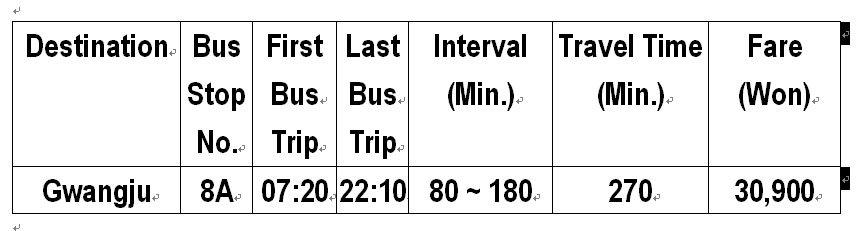
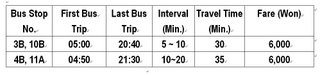
You can get information on buses to Gwangju and purchase the bus ticket at the Transportation Information Counter on the arrival floor of the airport passenger terminal. After buying your ticket, proceed to Bus Stop No.8A for the bus to Gwangju. The map of the arrival floor of Incheon International Airport and the bus schedule from Incheon Airport to Gwangju Bus Terminal are below:

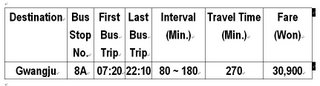
Domestic Flight. If you would like to fly to Gwangju, you must go to the nearby domestic airport Gimpo Airport. You can buy a bus ticket to the domestic airport at the Transportation Information Counter. It takes about 40 minutes to get to Gimpo Airport from Incheon International Airport by bus. The schedule for the bus to Gimpo Airport from Incheon International Airport is as follows:

8. Life in Gwangju

a) Dining, drinking, and singing culture. Koreans love to eat. The cityscape is peppered with restaurants, convenience stores, street vendors, etc. They normally drink alcohol when they eat their meals. After meals don’t be surprised to be invited to another bar or norae bang (Singing Room) for another round of drinking or singing and drinking.

b) Korean Class. Learning Korean language will be an advantage in your stay in Korea since English is not widely spoken. The foundation will provide a Korean teacher. The interns will be asked to share a minimum amount so as to encourage them to learn the language. The rest of the fees will be on the account of the Foundation.
Holidays. Korea celebrates different holidays like the Chuseok and Seollal. Some staff would invite interns to celebrate with them these events. Also, the office conducts its summer outing and other get together.

c) Accommodation Facilities. Two (2) female and two (2) male interns will separately share a single large room equipped with simple furnishings. The flat has a kitchen and a shower and toilet. The Korean electrical supply works on 220 volts, so if you bring any electrical equipment make sure it functions on this voltage range, or else bring a transformer.

Fees for flat rent, water, electricity and monthly telephone (cable TV/internet) subscription will be charged to the account of the foundation. Long distance or overseas calls will be charged to the account of interns. Use of phone card is advisable.


9. Weekend Activities

Gwangju, a bustling city of 1.4 million inhabitants, nestled at the foot of Mudeung Mountain (1,187m), boasts a number of interesting local attractions. Mudeung Mountain, which is usually snow-covered in winter, can be easily reached by public bus. It has hiking paths, cozy restaurants, and small temples dotting its slopes.

Near the city is a cultural park, home to the Gwangju National Museum with priceless historical and archaeological relics and the Gwangju City Folk Museum, which is the third largest city museum in Korea and is an excellent window into various aspects of Korean culture such as traditional Korean cuisine, time-honored Korean customs, folk games, and shamanistic rituals.

For those interested in art, the Gwangju Culture and Art Center, the Gwangju City Art Gallery and the inner-city's "Art Street" can be visited. On Saturday mornings, a small antique market is held in the "Art Street" area.
With short bus trips, the Korean coast, several nearby islands and number of other cities can be reached in day trips from Gwangju. Korea has a very efficient and cost-effective bus transport system and the Gwangju Bus Terminal is a regional hub for the southwestern part of the country.


10. General Information

a) Weather

Korea has four distinct seasons and it is normally very cold and snowy in winter, from December to February. It is advised that interns bring warm clothing for their stay in Korea, as well as hiking shoes for field trips. During summer it is both warm and wet, there will be occasional rain showers.

b) Internet and Communication Facilities

Out of the work, one can easily find internet cafes, called "PC Bangs" in the streets of Gwangju City. Charges for computer use range from 500 to 1,000 won (0.45 ~ 0.90 US dollar) per hour. Use of telephone card is advisable both for home and public phone calls for overseas calls.

c) Using Public Transportation

Public buses run frequently in major routes of the city. Fare usually starts at 900 won that is paid upon entry at the front door of the bus. Use only exact amount since driver will not have change for bills over 1,000 won. The base taxi fare is 1,500 won.

d) Social Communities

The GIC. GIC was established by the Gwangju City Government and Gwangju Citizens Solidarity in 1999 as a model of governmental and NGO collaboration. Its mission is to provide foreigners with information and services, promoting an international exchange in the fields of culture and economy and fostering international awareness among Korean youth through active involvement in helping the international community of Gwangju and Jeolla-namdo. GIC’s services include public talks, Korean language and calligraphy classes, offers guided tours and publishes a monthly magazine among others. There are church groups, government officials and student English groups or clubs, etc.

e) Recreation and other Facilities

518 Memorial Park. The park is hilly with plenty of trees and ground to do picnic. It is an ideal place to stroll and jog. There’s a Pagoda on top of it that is a good place to view the cityscape. Located within the 518 Memorial Park is the Student Center with facilities such as restaurant, study area, swimming pool, basketball court, table tennis, badminton, ballroom dancing, etc. The center also offers lessons and courses on arts and sports.

Restaurants. Eating places could be found everywhere in Gwnagju City, be sure to speak in Korean if you want to order food otherwise dine with someone who could speak the language.

Cinemas. Movie houses could be found in Sangmudong area and downtown.

Saunas. Saunas have become a theme park for Korean families. After a good/nice bath families or couples would join together in common areas where different Sauna facilities and amenities could be enjoyed such as restaurant/snack bars, singing rooms, video rooms, PC rooms, sauna hot-cold rooms, etc.

Tourist Information Center. Refer to information kiosks widely available in strategic locations to get maps and information about parks, museums and other significant landmarks both in Gwangju City and other parts of Korea.


11. Miscellaneous Information : What was it like to be an intern

Frankly, before I came here, I almost knew nothing about Korea, especially on Gwangju Uprising. All I knew about Korea is that it has a strong labour movement, as it was frequently published in the media in my country, Indonesia.

Being an intern here in the May 18 Memorial Foundation gave me a lot of opportunities of learning about the democratization process in Korea. Since I worked for a victim-based organisation, what attracted my attention the most is the victim's movements here in Korea as it will be an important lesson to be shared with Indonesian victim's community.

Through this internship I was also able to interact with some people or groups working on some other issues beside those 'victims things', such as: labour, urban poor, housing rights, women, migrant worker, environment, lawyer, academe, youth, etc. They were not necessarily Korean people, but members of the international community as well, especially Asian. Those interactions had equipped me with such fruitful knowledge and network.

Besides the learning from my Korean experiences, I also had an opportunity to share Indonesia’s current issues. Like once, with the support from my co-interns and the staff of the foundation, we conducted a signature campaign to commemorate the 1st death anniversary of Munir, an Indonesian human rights activist who was murdered on September 8, 2004. We were able to gather about 800 signatures from the citizens of Gwangju City. The collected signatures were sent to Indonesia as a show of solidarity of Korean people for the Munir case.

Living here for some period of time has also led me to experience Korea’s cultural traditions that are new and sometimes quite strange for me. The language, the food, song, values, manners or attitude, work ethics, etc. were all invaluable parts of my total experience of Korea! Mixture of fun, happiness, sadness, excitement, disappointment, anger, and all of other kinds of feelings and emotions have collided inside of me. But I think it's just common and natural. Above all, this internship has a special meaning for me personally :).

One thing that has impressed me is that the people here have a quite high respect for the sacrifices of the people in the past. I think this custom has influenced the process of reaffirming justice especially in case of dealing with the past human rights violation. And it has strengthened Korea as a nation.
Agnes Gurning (IKOHI, Indonesia)

I had a hard time for the first three months of my internship. Coming from an NGO culture, I found the culture of the foundation quite strange. Since we were pioneers we spent sometime trying to figure things out. For most pioneers a new endeavor is like trial and error. So I suggests in order to make the gap of expectations smaller of both interns and the Foundation the aim and the out put of the programme activities should be made clear for all concerned.

Also, at first, most of my expectations of the internship did not match with the real programme of the internship. The tasks I helped implemented such as Gwangju Asian Human Rights Folk School, Gwangju Forum for Asian Human Rights, Gwangju Prize for Human Rights Award 2006; and the different activities such as NGO visits and attending seminars or symposium made the internship more meaningful. Also, I became a speaker in Gwangju Human Rights Film Festival and responsible for inviting Indonesia’s famous rock band called Slank Band for the "Echo of Asia", a peace concert. The most important achievement I got from this programme that enhanced my personal achievements as well was the campaign on Indonesia and Aceh's human rights abuses specifically the campaign on the Case of Munir. Since the foundation holds several events and invites participants from other countries, I believe that The May 18 Memorial Foundation is the right organization to help and support Asian countries with their campaigns.
Mustawalad (KontraS, Indonesia)

My internship was a very unique and worthwhile experience. I always believed that traveling and living in a foreign country broadens one’s horizon, so that makes me want to travel some more. Having Koreans NGO partners and friends in the Philippines made me acquainted with things Korean, in a way made it easy for me to adjust in my stay here in Gwangju City. Although, I am so envious of the success of democracy that the May 18 Gwangju Democratic Uprising gave birth to, paving the way for an economic miracle here in Korea, that envy is fueling my zeal and enthusiasm to continue with my NGO work in the Philippines. Definitely there will be a time for us Filipinos to turn-around our current state of just a banana and labor exporter to Korea. I look forward for that time to come in my lifetime.

I particularly liked the trust I was afforded to do as an intern. Also, the unity and cooperation among us interns was great. Despite cultural and religious differences we were able to transcend them and we could say that we became more than colleagues but real friends if not brothers and sisters. I hope that I have contributed to the aim and objective of the internship program and optimistic that the little accomplishment I and my co-interns have done would be the basis for the next batch to improve on and make greater contributions for the continued success of the internship program. I wish the next batch of interns to take maximum benefit both in their professional career and personal growth in this internship program.
Pete Rahon (CO Multiversity, Philippines)


12. Contact Persons:

Should there be any problems or changes with your planned trip to Gwangju, please contact the May 18 Memorial Foundation through


Mr. Chanho Kim
Director, International Cooperation Team
Mobile: +82 10 4642 6650 (international)
010 4642 6650 (local)
E: surnadal@hanmail.net

Mr. Sang Seon Kim (Chris)
Staff charged for International Solidarity
Mobile: +82 10 8000 8052 (international)
010 8000 8052 (local)
E-mail : chriskim109@gmail.com


Address:
The May 18 Memorial Foundation
5.18 Memorial Culture Hall
Seo-Gu Sangmudong 1268
Gwangju City
Post Code 502-260
Republic of Korea
Phone: +82 62 456 0518
Fax. +82 62 456 0519
W: www.518.org
B: 518interns.blogspot.com

Thursday, March 16, 2006

Red Festa Video and Pix Gallery


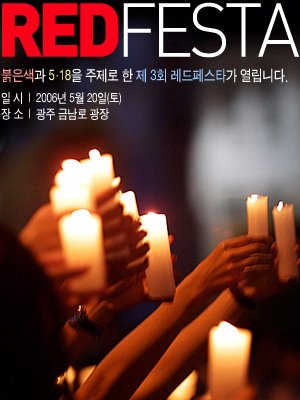
This is the internet ad for Red Festa 2006. Click the link below to watch the pix gallery of Red Festa 2005 (http://www.518red.net/html/photoContent.asp?seq=682 click the leftmost button 이전글 in Korean to scroll).


Click to watch video or cut and paste: http://www.518.org/file/mv/red.wmv

This video is a documentary of Red Festa 2005 commemorating and celebrating the heroic deeds of the people of Gwangju in the May 18, 1980 Gwangju Democratic Uprising. The language is in Korean.


Visit: http://www.518red.net (sorry but available in Korean language only)

Wednesday, March 15, 2006

Song of May: Nostalgia and Euphoria of May 1980


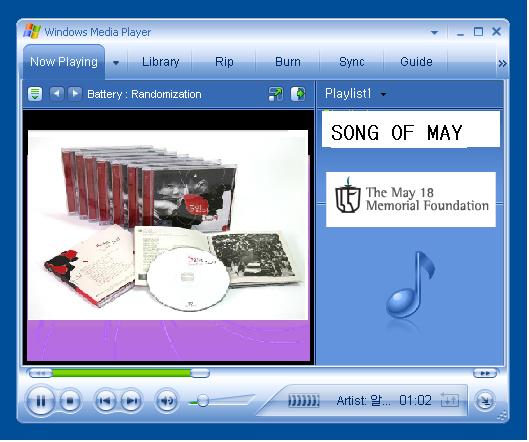
Click to listen to Song of May, the music is in Korean. These are songs about the May 18 Gwangju Democratic Uprising.


Song of May: Nostalgia and Euphoria of May 1980

After the incident of May 1980, we have crossed a bridge where we cannot go back. So many people were massacred by the militarists that disguised themselves with democracy and justice, and there is no one who won’t feel guilty in front of those corpses. In an era where we had to fight in order to survive, our agitation had no choice but the revolution for a fundamental transformation defying any romantic feelings.

Going beyond grief, so many songs came out that became weapons for the struggle and overcame the darkness of that era. Also, with the effort of those who lived passionately with music, we now enjoy music as music itself. After 26 years, we produced this album to commemorate the May 18 Gwangju Democratic Uprising in order to remember and immortalize that fateful incident.

If it weren’t for those songs of gruesome deaths and the steadfast for hope, we might not have the sense of pride talking bout May 18 like we do now. Knowing the values of those songs that were alive from that era, we wanted to include all of them to this new album. However, we only selected 13 songs for realistic reasons. These are songs that contain the grief and rage of May 18. Reminiscent songs that have been written after the event are also included making this a great collection music album. We made effort to have it as a representative of various genres for your listening pleasure. For musicians who remember May 18, it is certainly necessary for us to make this album delivers not only a clear message but also to make it as high quality music as well.

The first song “Song of May – 3” is a powerful song that interprets the 5.18 as the hope of a huge history. It is quite easy to feel the solid harmony of the drums and piano, performed by the group “Salm, Treut, Sori”. Even if a Magnolia Sheds” boasts its extraordinary lyricism which likens magnolia to sadness of the May 18 incident, sung well by Jin-oh Moon’s delicate vocals. Joo-sun Choo’s song “Gwangju Brook” is a song which shows the lonely sorrow and resentment through a quiet cello, making the listeners dazed by bringing them back to the day May 18, 1980. The “Song of May -2” represents the May 18 incident, and it is re-arranged into a rock version, delivering the rage livelier than ever. Byung-hwee Sohn’s “The Story of May” is a song that throws a gentle wave through an arrangement of a simple guitar and ocarina. It makes us feel a great impression, but as we hear Chi-hwan An and Tae-choon Jung’s passionate voice, it reminds us of the unfinished task of the 5.18. The “Song of May 1”, was arranged in the hymnal-style that appeases to our wound serenely, while “Huckleberry Finn’s” rock version “March For Thou” enthuses us to follow them.

Although the song has the musical language of 2006, it goes beyond and captures the essence of May 18, 26 years after. The late Mr. Nam-ju Kim’s poem recitation “Massacre”, like a hammer pounding, is one of the greatest poems about the 5.18 which still offers a very moving and powerful impression. Ggotdaji’s “Advancing May” is played with actual sounds from the scene, and is just the right song for a requiem. “Oh Gwangju O Moodeungsan” is a hymnal-arranged piece that enables us to embrace a great peal of the 5.18 spirit that has been restored with magnificence. “Mwetbinari” is a Korean traditional style song that has been arranged with a theme of “March for Thou”. With its flowing and intense composition, it adorns the finale of the album excellently.

This album is filled with nostalgia of restoring the scenes at that time and the euphoria of reinterpreting those scenes as viewed today. For musicians who remember it, the 5.18 is a powerful event that made them who they are today, and it will be continually viewed as move towards progress.

This great album that had overcome different challenging situations was finally published through collaborative effort and passions of all those who helped with the work. We would like to thank all the musicians who helped directly and indirectly. Also, we hope that the song collections serve as a medium to keep the ideals and values of 5.18. This is the courtesy we can give to those who gave their own lives in order to defend democracy to the last that we now enjoy.


(Edited from the review: Publishing the 5.18 People’s Uprising Memorial Album of Min-Gaph Se Jeong, a popular music reviewer.)

Thursday, March 09, 2006

ACT NOW! Gwangju Prize for Human Rights Award 2006


The Gwangju Prize for Human Rights was established to celebrate the spirit of May 18 Gwangju Uprising by recognizing both individuals, groups or institutions in Korea and abroad that have contributed in promoting and advancing human rights, democracy and peace in their work. The prize is awarded by the citizens of Gwangju in the spirit of solidarity and gratitude from those whom they have received help in their struggle for democratization. It is hoped that through this award the spirit and message of May 18 will be immortalized in the hearts and mind of humankind.

The Gwangju Prize for Human Rights which is given yearly has the following aims:
1). To enhance the spirit of the May 18 Democratic Uprising by awarding individuals, groups or institutions in Korea and abroad on their contribution to improving human rights and peace throughout the world.
2). To reward individuals, groups and institutions in Korea and/or abroad for promoting the goals of the May 18 Democratic Uprising as a movement toward unification and cooperation.

A prize money amounting to US$ 50,000, a gold medal and a certificate will be awarded to the winner.


Previous Winners of the Gwangju Prize for Human Rights:
2000 (3rd Nov) : Xanana Gusmao (The president of East Timor)
2001 (18th May): Basil Fernando (Executive director of AHRC; Hong Kong)
2002 (18th May): Korean Association of Bereaved Families for Democracy; South Korea
2003 (18th May): Dandeniya Gamage Jayanthi (Monument for the Disappeared; Sri Lanka)
2004 (18th May): Aung San Suu Kyi (National League for Democracy; Burma)
2005 (18th May): Wardah Hafidz (Coordinator, Urban Poor Consortium; Indonesia)


Nomination and Criteria
The candidates eligible for the Gwangju Prize for Human Rights are nominations made by individuals or organizations who were invited to nominate names for consideration. An individual can not nominate himself or herself. These core criteria should be considered:
1). Outstanding person or group that is active in the promotion and advocacy of Peace, Democracy and Human Rights.
2). A person or group that works for the reunification of Korea.


The Gwangju Prize for Human Rights Committee
Gwangju Prize for Human Rights Committee is responsible for the selection of the candidates and the choice of prize winner. The Committee is composed of individuals appointed by the Board of the May 18 Memorial Foundation.

Information about the nominations, whether publicly or privately is confidential. Disclosure is highly restricted.

Timeline and Process
1). January-February
Announcement and nomination forms are sent out. The Committee sends out invitation letters containing forms to persons who will be requested to nominate.
2). 30 March 2006
Deadline for submission of the forms. The Committee assesses the candidates' work and prepares a short list.
3). April
The “shortlist” is reviewed by the committee and advisers will be consulted for their input and knowledge of chosen candidates. The advisers do not directly evaluate nominations nor give explicit recommendations. On April 27, 2006, committee members will choose a winner and the next day public announcement and press conference will be held in Seoul to announce the winner.
4). 18 May 2006
The Gwangju Prize for Human Rights Award Ceremony will be held. The prize winner receives the award.
________________________


Frequently Asked Questions
Gwangju Prize for Human Rights 2006

What is the Gwangju Prize for Human Rights?
The Gwangju Prize for Human Rights was established by The May 18 Memorial Foundation to celebrate the spirit of May 18 Gwangju Uprising. It is awarded as recognition both to individuals and groups or institutions in Korea and abroad that have contributed in promoting and advancing human rights, democracy and peace in their work. The prize is awarded by citizens the Gwangju in the spirit of solidarity and gratitude from those whom they have received help in their struggle for democratization and search for truth. It is hoped that through this award the spirit and message of May 18 will be immortalized in the hearts and mind of humankind.

What are the aims of the Gwangju Prize for Human Rights?
The Gwangju Prize for Human Rights is given yearly and has the following aims: 1) to enhance the spirit of the May 18 Democratic Uprising by awarding individuals, groups or institutions in Korea and abroad on their contribution to improving human rights, democracy, and peace throughout the world. 2) to reward individuals, groups and institutions in Korea and/or abroad for promoting the goals of the May 18 Democratic Uprising as a movement toward unification and cooperation.

How can I nominate someone for the Gwangju Prize for Human Rights?
The candidates eligible for the Gwangju Prize for Human Rights are those nominated by qualified persons or organizations. The nominee must be an outstanding person or group that is active in the promotion and advocacy of Peace, Democracy and Human Rights, and a person or group that works for the reunification of Korea. The nomination form is available online in the English section of www.518.org website.

Is it possible to nominate, myself or my organization and someone for a posthumous Gwangju Prize for Human Rights?
No, it is not possible to nominate yourself or your organization, also, posthumous nomination is not allowed either.

What is the process of nomination?
The nominator should accomplish the requirements found in the nomination form, get two other referees to answer the questionnaire, and submit by post the accomplished forms and the relevant documents to The May 18 Memorial Foundation.

When and where to submit the nomination?
All nominations must be sent by post to The May 18 Memorial Foundation not later than March 30, 2006.
Nominations should be mailed to:
The May 18 Memorial Foundation
c/o Gwangju Prize for Human Rights 2006
518 Memorial Culture Hall
Postcode 502-260
Seo-gu, Sangmudong 1268,
Gwangju City, Republic of Korea

Who will decide the winner for Gwangju Prize for Human Rights?
The Gwangju Prize for Human Rights Committee is responsible for the selection of the candidates and the choice of prize winner. The Committee is composed of individuals appointed by the Board of the May 18 Memorial Foundation. Information about the nominations, whether publicly or privately is confidential. Disclosure is highly restricted.
When will the winner be announced?
The winner will be announced on 28 April 2006 in a press conference that will be held in Seoul.

How many winners have been awarded the prize?
Since 2000, five individuals and 1 organization have been awarded the Gwangju Prize for Human Rights.

What is awarded to the winner?
Prize money amounting to US$ 50,000, a gold medal and a certificate is awarded to a winner.

When and where will the Gwangju Prize for Human Rights ceremonies take place this year?
The Gwangju Prize for Human Rights ceremonies will be held at the Gwangju City Hall, Gwangju City, South Korea on 18 May 2006. Republic of Korea.


For more information please send email to:
surnadal@hanmail.com (Chanho Kim)
mwalad@gmail.com (Mus)
518org@gmail.com
Visit our website: www.518.org

World Cultural Artist Meeting


World Cultural Artist Meeting
Video sent by Mustawalad
This Video was taken during Gwangju forum for Asian Human Rights in Gwangju South Korea.

The video was taken by Mus and uploaded it, I enjoyed dancing with a participant from the Literary Group who had their conference simultaneous with the Forum we held. The event was in line with the ground breaking of the Asian Culture Center in Gwangju City, ROK.

Sunday, March 05, 2006

The May 18 Memorial Foundation


The May 18 Memorial Foundation
Video sent by peterahon
This video is about the May 18 Memorial Foundation, Gwangju City, Republic of Korea. It depicts the May 1980 Gwangju Democratic Uprising. (Note this video is 140 MB in size).

Support Amnesty International